Most UK homes have one, and most of them are a mess. The cupboard under the stairs is an odd shape by nature: full height at one end, a few inches at the other, often with the electric meter, the vacuum cleaner and last year's Christmas decorations all fighting for the same patch of floor. Because it is out of sight, it is also the first place anything homeless in the house ends up, until opening the door means bracing for whatever falls out.
The fix is not a bigger cupboard. It is treating the space like the three or four different zones it actually is, sized to what each part of the slope can genuinely hold, instead of one deep hole you throw things into. These 20 ideas work through it end to end: what goes at the tall, easy-to-reach mouth of the space, what goes in the low, awkward middle, and what to do with the deep end if there is room to make it something other than storage.
Start at the mouth: shoes and coats
The first foot or two inside the door gets opened every single day, so it earns the storage that is easiest to use without bending or reaching.
-
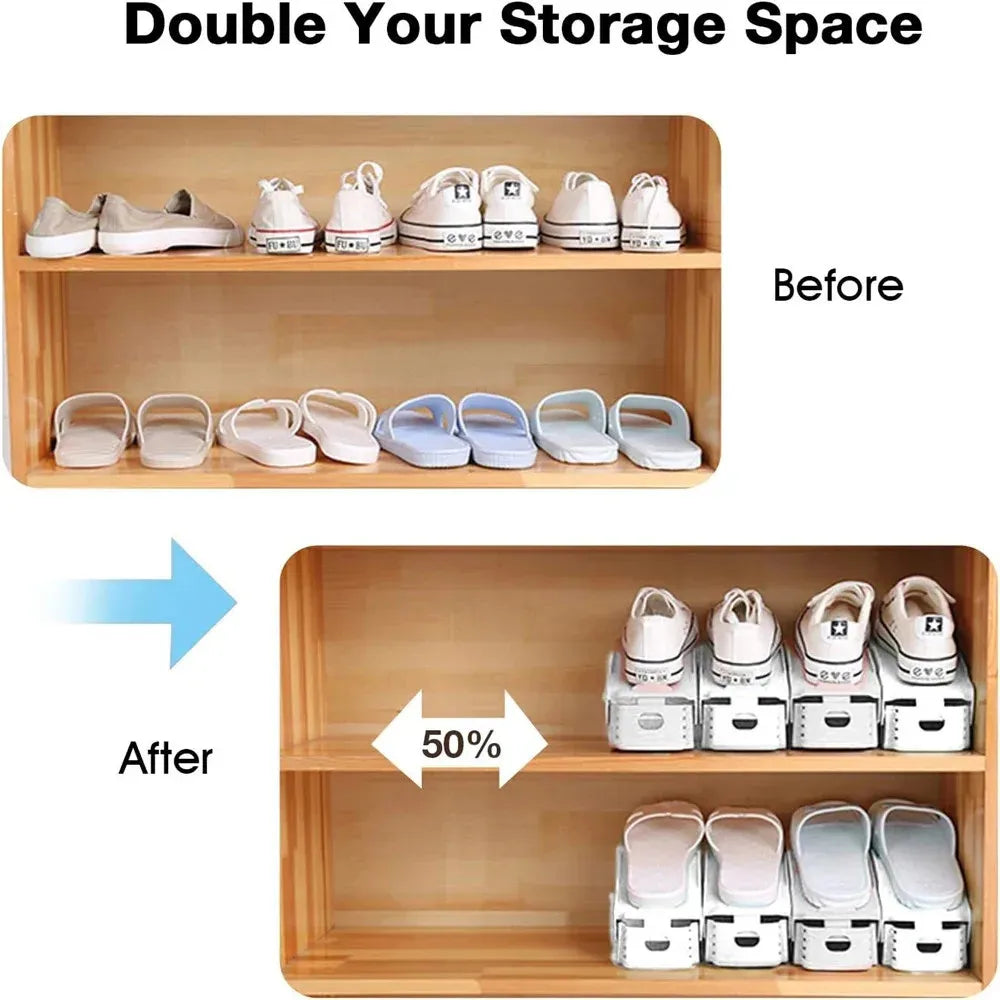
Fit a stackable shoe rack rather than a loose pile on the floor. A double layer shoe rack clicks together with no tools, adjusts to fit slippers through to boots, and roughly doubles what a single-layer rack holds in the same footprint. It is also freestanding, so it sits straight onto the floor just inside the door without any fixing into a wall that might be sloped or awkward to drill into.
-
Use the back of the door itself for everyday hanging. An over-door hook strip or hanging organiser catches keys, dog leads and school bags right at the entrance, keeping them off the shoe rack and off the floor entirely.
-
Put a boot tray or mat down first, before anything else goes in. Wet or muddy shoes stop at the tray rather than tracking further into the space, which matters more here than in an open hallway because nothing under the stairs gets a chance to dry out properly.
-
Hang coats on a proper wall-mounted rack, not a single overloaded hook. A piano key coat rack is solid wood with flip-down hooks that stay hidden until needed, so it works on the wall just inside or beside the cupboard door without looking like extra clutter, and it holds several coats and bags across its width rather than one hook taking all the weight.
Get the cleaning kit off the floor
Mops, brooms and vacuum cleaners are usually the heaviest, most awkward things stored here, and they are also what people reach for most often, so they deserve to stand upright rather than lean against everything else and fall over.
-
Mount cleaning tools to the wall instead of leaning them in a corner. A wall-mounted mop and broom holder grips the handle securely and fits with a no-drill, traceless mount, which matters in a cupboard where the back wall may follow the slope of the stairs and isn't always a straightforward surface to fix into.
-
Use its built-in hook for the small things that go with the mop. A dustpan, a spray bottle or a cleaning cloth hung on the same fitting means the whole cleaning kit lives in one place instead of the spray bottle rolling around the floor separately.
-
Keep sprays and cloths in a lift-out caddy rather than loose on a shelf. A caddy with a handle can be pulled out and carried to wherever you're cleaning, then put straight back, which is faster than reaching past everything else stored deeper in the cupboard.
-
Give the vacuum cleaner its own named corner. Standing it upright in one fixed spot, rather than wherever it happens to land after the last time it was used, is what stops it from becoming the one object that blocks access to everything behind it.
Do not let a single door block half the space
This is the mistake that turns a promising cupboard into a black hole: one deep door, one shallow shelf just behind it, and everything past that shelf effectively lost. Ideal Home's own reporting on tidy under-stairs cupboards makes the same point directly, that leaving the space open rather than boxing the whole thing behind one access point is what lets you actually use the full depth of a tight area.
-
Consider leaving part of the space open rather than fully enclosed. A single open bay with shelving or a rail, rather than a solid door across the entire cupboard, gives you a sightline and a reach into the whole depth instead of just the first foot behind the opening.
-
Measure the actual door opening and depth before buying any storage unit. A shelving unit or crate that is wider or deeper than the doorway itself will sit stranded once it's in, blocking the exact access it was meant to create.
-
Choose pull-out drawers or a sliding rail over fixed shelving wherever the ceiling drops sharply. Fixed shelves at the low end of the slope mean crouching or crawling to reach the back; a unit that pulls toward you brings the contents to the door instead.
-
If something outside the cupboard is what's really blocking access, deal with that first. A console table, bench or shoe cabinet sitting in front of the door is a common reason the whole space becomes hard to use. A furniture roller set and lifter tool raises one leg of a heavy piece at a time with a lever, just enough to slide a roller underneath, so it can be shifted aside without wrestling it or waiting for a second pair of hands.
Label everything before it goes in
Ideal Home's interviews with people who keep a genuinely tidy under-stairs cupboard come back to the same habit again and again: everything sorted into its own labelled category, cleaning products in one basket, spare batteries and cables in another, rather than one mixed box that has to be tipped out to find anything.
-
Print real labels rather than relying on memory. A portable thermal label printer connects over Bluetooth to an app on your phone and prints straight away with no ink cartridges, so labelling a shelf of boxes takes minutes rather than becoming a job you keep putting off.
-
Sort by category, not by whatever box was nearest when you were tidying up. Cleaning products together, cables and batteries together, seasonal items together: the categorisation matters more than the container.
-
Group seasonal items so the box only comes out twice a year. Christmas decorations, off-season coats or camping gear boxed and labelled together means one clearly marked box gets pulled out at the right time of year, rather than being rifled through every time you're looking for something else.
-
Use uniform, stackable bins instead of mismatched boxes. Boxes of different shapes leave gaps that waste space under a sloped ceiling; matching bins stack flush and make the most of the height you actually have at the taller end.
Turn the deep end into somewhere, not just storage
If the tall end of the space is roomy enough to stand or sit in, it does not have to be storage at all. A small reading nook, a play den for kids, or a fold-down desk for a quiet corner can be a better use of the best bit of the space than another shelf.
-
Consider a fold-down or freestanding desk if there's natural light nearby. Even a narrow shelf that folds flat against the wall when not in use can turn a dead corner into a spot to answer emails or do homework.
-
Add a soft light for a den or reading corner rather than a bare bulb. A jellyfish night light runs cable-free on a rechargeable battery and has a steady glow setting alongside its colour-changing mode, so it works as a calm, fixed light for a kids' reading nook without needing a socket built into the cupboard.
-
Add a cushion or a small floor seat if it's becoming a child's den. Kids tend to claim awkward little spaces like this on their own anyway; a cushion just makes it comfortable rather than something they're squeezing into.
-
Keep the "somewhere" part physically separate from the working storage near the door. A curtain, or simply respecting the natural point where the ceiling drops too low to stand, stops the storage end slowly creeping into the space you wanted to keep clear.
The pattern underneath all of this
Every idea here comes back to the same three things: keep the space accessible rather than boxed behind one door, sort by category instead of by whatever fits, and match the storage to the shape of the slope instead of fighting it. Get those three right and the cupboard under the stairs stops being the room nobody wants to open. Browse the full Home Organisation collection for more pieces that work in tight, awkward spaces like this one.
Frequently Asked Questions
How do I maximise storage in an under-stairs cupboard? Work with the slope rather than against it: full-height shelving or a shoe rack at the tall end, pull-out drawers or a rail at the low end where crouching is uncomfortable, and a boot tray right at the door for anything wet. Measuring the exact door opening before buying any unit avoids ending up with something that blocks its own access.
Should I leave under-stairs storage open or fit a single door? Leaving at least part of the space open, or fitting a rail or shelving unit rather than one deep door, generally makes the whole depth of the cupboard usable, since a single access point at the front can otherwise leave everything behind it effectively out of reach.
How do I stop an under-stairs cupboard becoming a dumping ground? Sort what goes in by category rather than by whatever's nearest, label the boxes so you don't have to open each one to check, and give heavy or awkward items like the vacuum cleaner a fixed spot of their own so they don't end up blocking everything else.
Related Reading